
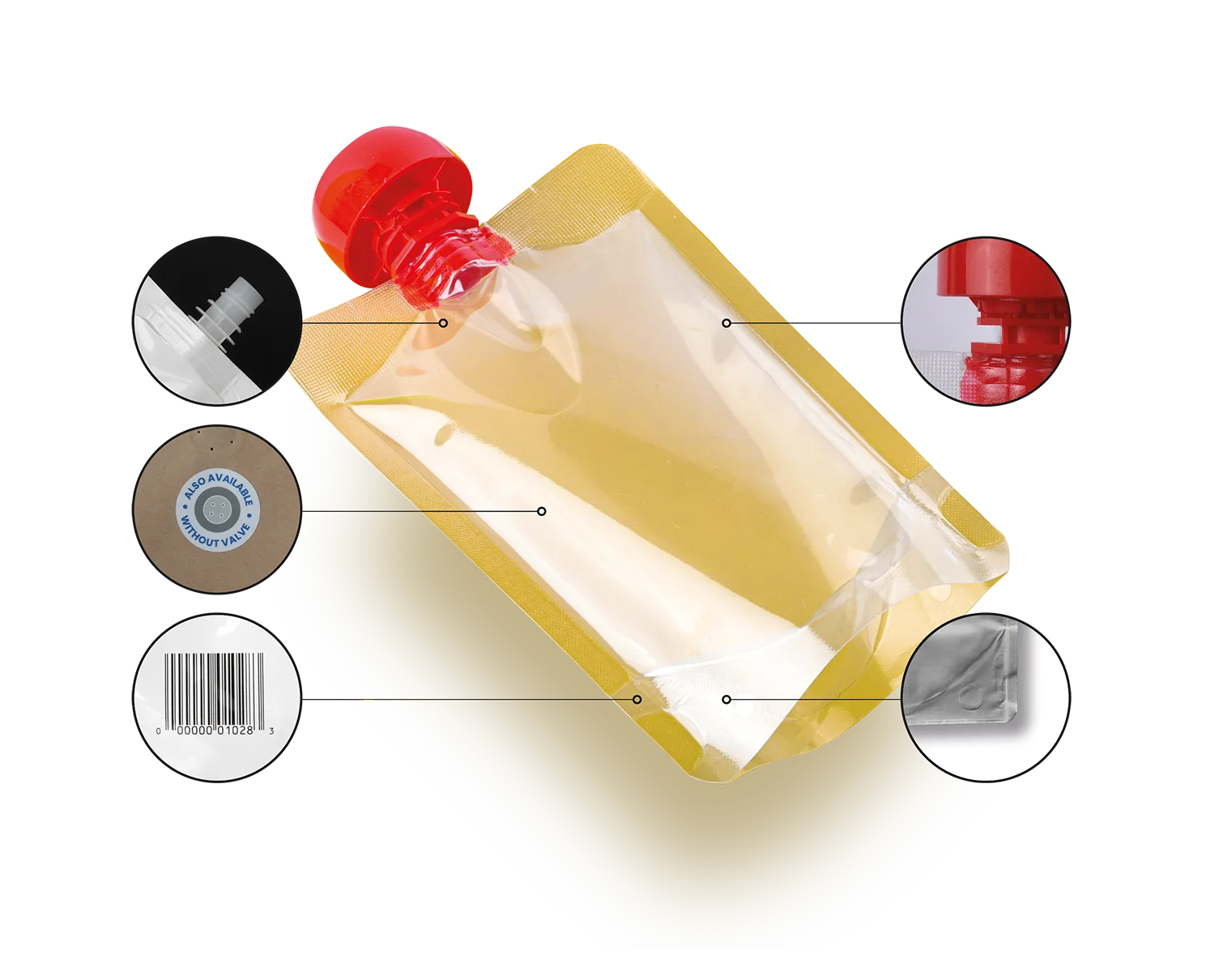
Leak detection
- At the bellows
- On the sides
- Around the cap
Dimensional conformity
- Measurement of the pouch components
- Comparison with expected measurements with configurable tolerance
Product identification
- Barcode reading
- Recognition within a catalogue of references
Consumer safety
- Sharp edges
- Delaminated film
- Broken cap
Visual conformity
- Stains
- Deposits
- Printing problems

Mechanical integration
Vision integration:
key points
Handling of pouches flat or upright depending on priority control points.
Well-timed and repeatable positioning to correctly visualise all control areas.
Distance from the ejection station to be defined according to the required analysis time (number of inspection points and cadence).

DEVELOPMENTS
Application specificities
Variety of pouches: more or less reflective film, cap or zip closure, wet or dry contents.
Numerous inspection points with different rules.
Constraints relating to maintenance, camera visibility and space requirements mean that choices must be made regarding the areas to be monitored (two sides or one side and bellows).

OPTICS
Lighting
Ensure there is sufficient light so as not to slow down the shooting process.
Light the bellows well, right into the corners, to detect any leaks.
Use a polarising filter on the light source and on the camera.

TIPS
Gabrielle’s tips
To optimise leak detection:
Specialise the detection model by training it on the symptoms specific to your product (e.g. swelling, leakage, delamination).
Apply slight mechanical pressure to your pouches; this will better reveal any side leaks.
Check the seal as soon as it comes out of the thermoforming machine, using an infrared camera.