
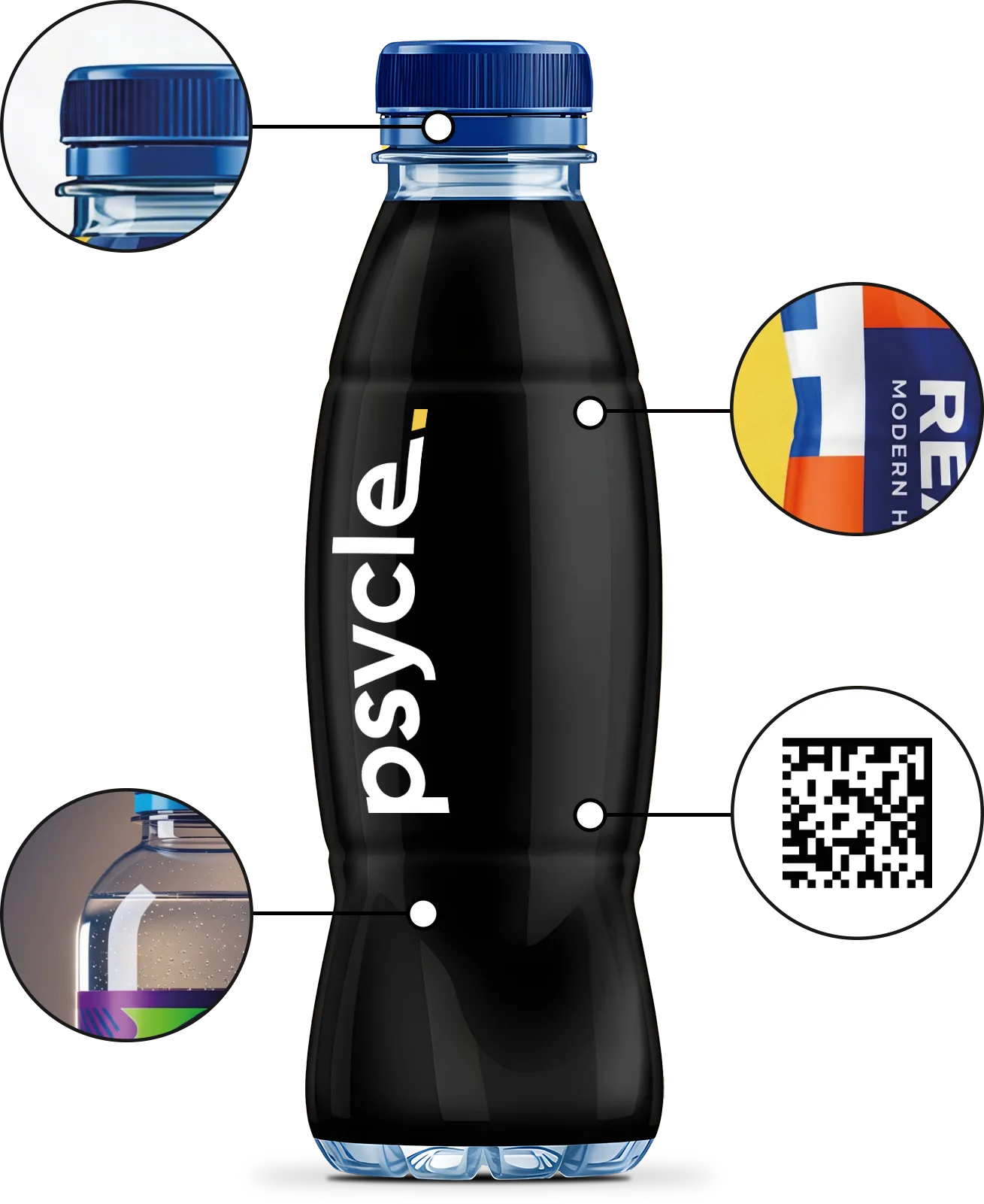
Cap / Capsule
- Presence detection and reference verification
- Crimping control (detection of defects smaller than 1 mm)
- Detection of aesthetic defects (dirt)
Sleeve
- Presence detection and reference verification
- Positioning verification (height and angle)
- Sleeve integrity verification
- Detection of welding defects (flags) or shrinkage defects (creases, bubbles)
- Detection of defects in the sleeve (flags, creases, bubbles)
Bottle
- Detection of defects (black spots)
- Detection of drips
- Checking the fill level
Marking
- Barcode, QR code, and Datamatrix reading
- Reading and verification of best-before dates

Mechanical INTeGRATION
Integration of the vision station
4 cameras for 360° monitoring and a 5th for a top view.
Provide a bottle spacing system upstream of the monitoring station.
Ejection as close as possible to the monitoring station to minimize delays.

DEVELOPMENTS
Challenges of implementation
High-speed inspection of numerous elements on lines processing a wide variety of formats and designs, with minimal camera adjustments.

OptiCS
Points to keep in mind
Adapt the ambient lighting to the product (opaque or transparent).
Ensure its stability.
Flash as the products pass by to avoid blurring.
Take into account the variability of formats when choosing the focal length of the lenses.

TIPS
Meziane’s tips
Prefer a connection to the encoder rather than to the counting cell to manage ejections.
Separate appearance inspection and marking reading for very high speeds.
Opt for adjustable lenses (mechanical or liquid) if you have a wide range of bottle formats.